
Key findings:
- Setting a sat nav destination to “home” takes 15.21 seconds – long enough to travel 204 metres at just 30mph, or nearly two full football pitches.
- At 70mph, that same task covers 476 metres – more than four and a half football pitches.
- Across all the tasks tested, drivers spend anywhere from 71m in a Skoda to 188m in a Genesis with their eyes off the road at 30mph, depending on the car brand.
- More than half (54%) of drivers agree in-car touchscreens make simple tasks harder to complete quickly than physical buttons would.
- 42% of drivers have avoided buying or leasing a car because its main controls are touchscreen-only.
- One in ten drivers have been in a serious collision as a result of being distracted by their car’s touchscreen while driving.
How Far Do You Travel With Your Eyes Off the Road Completing a Simple Touchscreen Task?
We looked at some of the he most common in-car touchscreen tasks there are, such as turning on the sat nav and selecting “home”, turning off lane-keep assist, tuning the radio, changing the temperature and switching on seat warmers.
The task requiring the most time from drivers was instructing the sat nav, which took drivers an average of 15.21 seconds to complete from start to finish. That might not sound like much, but at 30mph, that is enough time to cover 204 metres without giving the road your full attention.
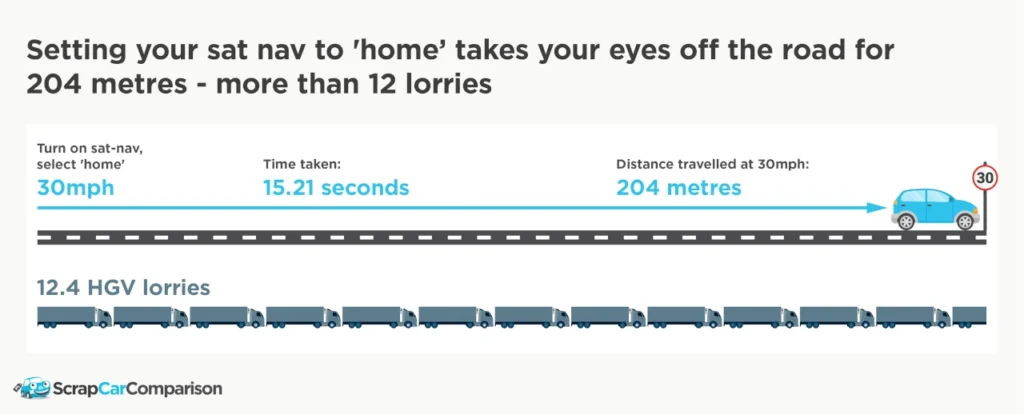
It’s a genuinely startling amount of ground to cover while your attention is split between the screen and the road, and that’s before factoring in traffic, pedestrians, or anything unexpected happening in those two football pitches’ worth of tarmac.
Sat nav wasn’t the only task that ate into a driver’s attention, either. Turning off lane-keep assist took an average of 12.67 seconds – nearly as long as the sat nav test – covering 170 metres at 30mph, or 1.6 football pitches, roughly the equivalent of 15 London buses or 10 HGV lorries lined up end to end.
Tuning the radio took 8.5 seconds, covering 114 metres (1.1 football pitches), while the quickest tasks tested – raising the cabin temperature by 2°C (4.49 seconds, 60 metres) and turning on heated seats (3.53 seconds, 47 metres) – still meant covering more than half a football pitch with your eyes off the road.
So while people may assume a quick task like setting a sat nav is a two-second job, in reality it’s closer to fifteen. That’s a genuinely dangerous amount of time to have your eyes off the road, especially somewhere unfamiliar or built-up.
How Far You Would Travel Distracted at Different Speeds
Speed changes everything. The same 15.21 seconds required to instructing the sat nav covers very different distances depending on how fast you’re going when you attempt it.
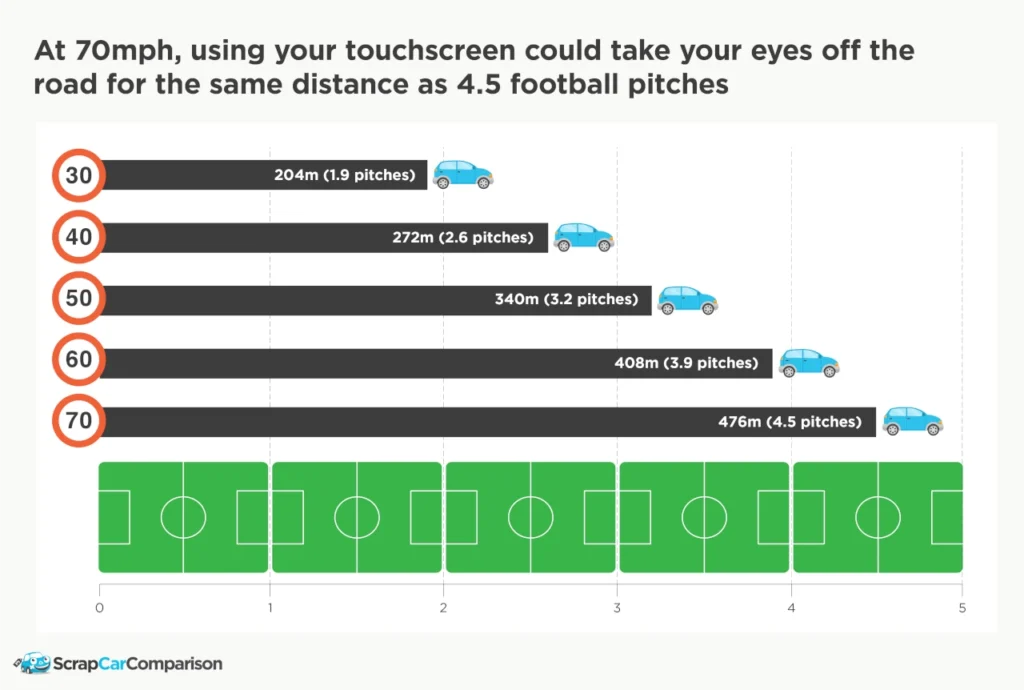
At motorway speeds, the same handful of taps on a screen can mean travelling 476 metres (or more than four and a half football pitches), without properly watching the road ahead.
The same pattern holds across the other tasks tested too, just at a slightly different scale. Turning off lane-keep assist – a task most drivers barely think twice about – still covers 340 metres at 60mph and 396 metres at 70mph, nearly four football pitches at motorway speed.
Tuning the radio to a different station adds up to 266 metres by 70mph, while even the quickest task tested, turning on heated seats, still covers 110 metres at that speed.
It’s an uncomfortable finding given that motorways are also where UK drivers feel particularly confident – our Confident Drivers research found 89% feel happy changing lanes and driving on a motorway generally. That confidence could easily work against drivers here: feeling more at ease on a motorway may make someone more likely to risk a quick touchscreen task, at exactly the speed where it costs the most ground.
Which Car Brands Take Your Eyes Off the Road the Longest?
Different car models have different touchscreens that can vary in size from large tablet-sized ones, such as in a Tesla, to screens no bigger than your smart phone (hello Mazda!). As a result, at a steady 30mph, the amount of ground covered with a driver’s eyes off the road varied hugely by car brand – from 71 metres in a Skoda to a huge 188 metres in a Genesis.
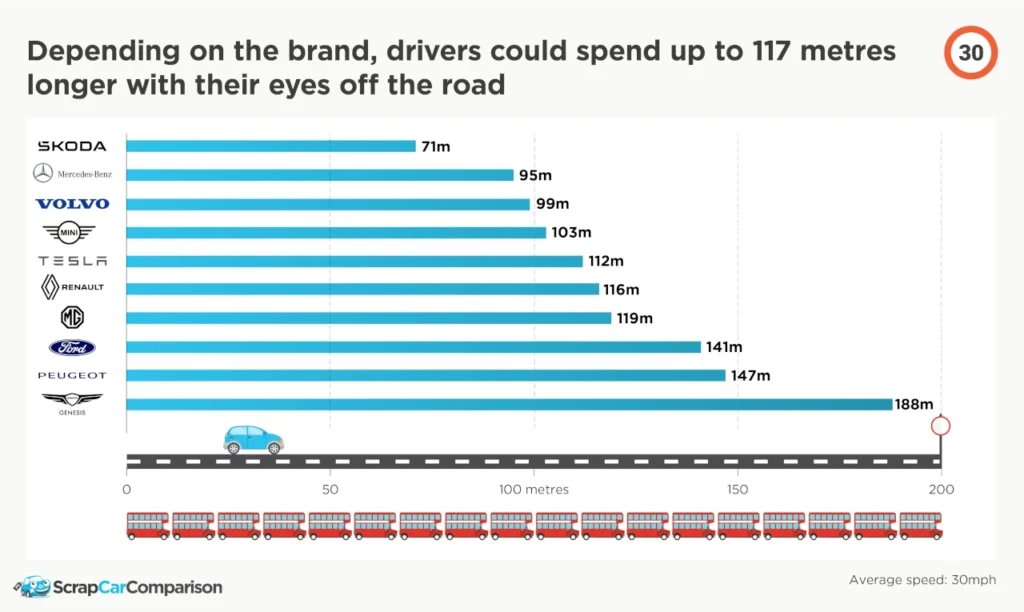
Genesis drivers cover more than double the distance of Skoda drivers doing the exact same tasks – a gap that’s likely down to how each brand has designed its in-car touchscreen menus. Deeper menu structures, smaller touch targets, and a lack of physical shortcut buttons can all add valuable seconds onto a task that should be simple, and those seconds add up fast at speed.
How Do UK Drivers Really Feel About Touchscreens?
We also asked 1,000 UK drivers for their honest take on in-car touchscreens, and the appetite for a return to physical controls is clear.
Over half (51%) wish car manufacturers still used physical buttons or dials for key functions, while a similar proportion (54%) agree that touchscreens make it harder to complete simple tasks quickly compared to physical buttons.
Nearly half (48%) go further still, admitting that struggling to use a touchscreen makes them feel old-fashioned or out of touch with modern technology. That fear isn’t unfounded – our Driving Age Report found trust in older drivers drops sharply with age, with 68% of UK respondents believing drivers over 75 are too slow or overly cautious on the road, and 77% saying they wouldn’t feel comfortable as a passenger with someone over 80 behind the wheel.
Furthermore, our Tedious Tech research into how UK drivers feel about car tech in general, found Lexus, Dacia and Audi owners report the highest levels of frustration with their in-car technology overall – all three brands have leaned heavily into touchscreen-based menus in recent years rather than sticking with physical dials.
Would Drivers Avoid a Car Because Of Its Touchscreen?
For a significant number of drivers, touchscreen frustration goes beyond mild annoyance and actually shapes what they buy. 42% of drivers say they’ve avoided buying or leasing a car because its main controls are only accessible via a touchscreen – 25% chose a different model or brand entirely.
UK Cities Who’ve Avoided a Car Due To Its Touchscreen
| City | % Who’ve Avoided a Car Due To Its Touchscreen |
| London | 53% |
| Cardiff | 50% |
| Norwich | 45% |
| Manchester | 45% |
| Birmingham | 44% |
| Sheffield | 29% |
| Edinburgh | 25% |
| Bristol | 24% |
London and Cardiff drivers are the most likely to have let a touchscreen-only cabin put them off a car altogether, while Bristol and Edinburgh drivers seem far more relaxed about it.
How Do Drivers Behave Behind The Wheel?
Attitudes are one thing, but behaviour tells its own story. More than a third of drivers (38%) say they always or often feel nervous or unsafe operating their touchscreen while driving, rising to 67% who feel this way at least sometimes.
There are some reassuring habits too – 55% say they always or often wait until the car is stationary before using the touchscreen for anything beyond essential driving functions. But 42% also admit to always or often feeling rushed or under pressure to finish a touchscreen task quickly so they can look back at the road, and 39% always or often ask a passenger to operate the touchscreen for them instead.
If you can, handing the task to a passenger is honestly one of the best things you can do. If a task can wait, or someone else in the car can do it, that’s a much safer choice than trying to do it yourself at speed.
Which Touchscreen Tasks Are Most Distracting?
We asked drivers which touchscreen tasks they personally find most distracting or difficult to do safely while driving.
Most Distracting Touchscreen Tasks
| Rank | Task | % Of Drivers |
| 1 | Entering a sat nav destination | 41% |
| 2 | Changing the music/radio station | 29% |
| 3 | Answering or making a phone call | 26% |
| 4 | Adjusting the temperature/climate control | 26% |
| 5 | Reading or responding to a notification | 24% |
| 6 | Adjusting other driving settings | 21% |
| 7 | Adjusting the volume | 20% |
Sat nav entry tops the list, matching the task we timed and measured in metres above, made even more difficult when it involves unfamiliar junctions or confusing roundabouts. Changing the music comes in a close second, proof that even something as habitual as skipping a song is enough to pull a driver’s focus away from the road.
It’s not all bad news for car tech, though – and voice control looks like the standout. Our Tedious Tech research found voice assistants are one of the least annoying features on the list, with just 12.8% of drivers finding them irritating. Perhaps talking to your car, rather than tapping at it, is the safer habit to build.
What Happens When Drivers Get Distracted?
Perhaps most concerning is what drivers report actually happening as a result of interacting with their in-car touchscreens. Almost a quarter (24.4%) have missed a turning or exit, and a similar number (22%) have had to brake suddenly.
Around one in five have swerved to correct their lane position (21%) or clipped a kerb or pavement (18%), while 13% have had a near-miss with another vehicle, cyclist or pedestrian. More seriously still, 11% have been in a minor collision, and one in ten drivers have been in a more serious collision as a result.
These aren’t hypothetical risks – one in ten drivers we surveyed has been in a serious collision after getting distracted by their touchscreen. Whatever the task is, whether it’s changing a song or setting a destination, it’s worth asking whether it can wait until you’ve stopped.
On average, drivers say they’re travelling at 26.55mph when they interact with their touchscreen – squarely within the range where our sat nav test alone would cover well over 150 metres blind-folded.
If your car’s ageing touchscreen or dashboard tech is more hassle than it’s worth, and the rest of the vehicle isn’t far behind it, it might be time to weigh up whether repairs or an upgrade make more sense – and if scrapping is the more practical route, that’s exactly where we can help.
Methodology
The task-time data used in this piece is sourced from a touchscreen distraction study in which a panel of drivers completed common in-car tasks – including turning off lane-keep assist, turning on the sat nav and selecting “home,” raising the cabin temperature by 2°C, turning on heated seats, and tuning to Radio 4 – across 10 car brands. We took their average completion times and converted them into distance travelled at speeds between 30mph and 70mph. Distances were then converted into real-world equivalents, including football pitches (105m), London buses (11.23m), and HGV lorries (16.5m), for ease of comparison.
The research was conducted by Censuswide, among a sample of 1000 UK adults who hold a full driving license and drive a car fitted with a touchscreen infotainment/control system. The data was collected between 28.07.2026 – 31.07.2026. Censuswide is a member of the Market Research Society (MRS) and the British Polling Council (BPC), and a signatory of the Global Data Quality Pledge. They adhere to the MRS Code of Conduct and ESOMAR principles.
Data correct as of August 2026.