How Much Does a Coolant Leak Cost to Fix?
The cost of repairing a coolant leak can vary greatly, from minor fixes at around £50 to major repairs costing upwards of £2,000. The average cost for a fix, across all issues relating to coolant leaks, sits at around £400.
Typical Costs by Repair
| Repair | Average price |
| Radiator small leak sealant | £60 |
| Repair/replacement of radiator hoses, sealant, connectors or cap | £100 |
| Radiator replacement | £350 |
| Water pump repair | £450 |
| Head gasket repair | £1.000 |
| Average coolant leak repair | £400 |
| Data from Checkatrade.com – September 2026 | |
Diagnosis and Pressure Testing
Pressure testing a coolant system allows you to find slow or hidden leaks without the need of turning the car on. It is a process that can be carried out at home with a simple kit, although tests on major leaks or issues deep within the engine bay should be left to professional mechanics.
DIY kits can be bought from parts specialists (such as Euro Car Parts) from £80 upwards, although you can find them on more generic shopping sites (Amazon etc) from as little as £35. All you need to carry out a test at home is a stone-cold engine and the patience to watch the test gauge after you’ve manually pumped it to the pressure listed on your vehicle’s radiator cap. If the needle drops within 10 to 15 minutes, then you have a leak.
To find the leak, you should inspect all hoses, seams, the water pump and heater core for any wet spots, drips or a hissing sound. If you can’t see any external puddles or drips, then check your engine oil. If it looks milky then there is an internal leak into the engine block.
Labour Rates Around the UK
The average cost of labour in the UK is around £60 an hour, with mobile mechanics slightly lower at £45 (although these often come with a callout fee to add on top). Costs are likely to be higher in London and the South East, where you can expect to pay from £70 an hour, whereas more rural areas, or Scotland and Wales, can be much lower at around £50.
Labour rates will also differ depending on where you go within your local area. Generally, independent garages offer a far cheaper rate than main dealers, which can reach £100 or higher anywhere in the UK
What Pushes the Price Up
Make, Model and Age
Your specific car has a big impact on the price you can expect to pay for repair costs. More premium brands, such as Audi, Jaguar, Mercedes etc have more premium price tags. In some cases, not only are you paying inflated rates for their replacement parts, but some brands require specialist diagnostic tools, which pushes the price up.
The age of your car can push the price up at either end of its life. The parts in older cars may be worn, with brittle plastic or rusted bolts that can snap during disassembly, which means they need replacing, adding both labour and parts costs to your bill. On the other end of the scale, the engine bays in more modern vehicles are much more compact, and in many cases mechanics need to remove other parts just to access the one they need to repair, adding time and labour costs as a result.
Where the Leak Is
If you just need a hose replacement, this will be quite a quick and simple fix and should keep your costs down. A radiator or water pump repair/replacement is going to cost more as the work adds up along with the cost of parts alone. Finally, an internal engine leak is likely to push the bill up to its highest level. These repairs require the majority of the engine to be torn down, and repairs can often take upwards of six hours. Taking the average cost of labour in the UK into account, that’s £360 on labour alone.
Coolant Type and Refill
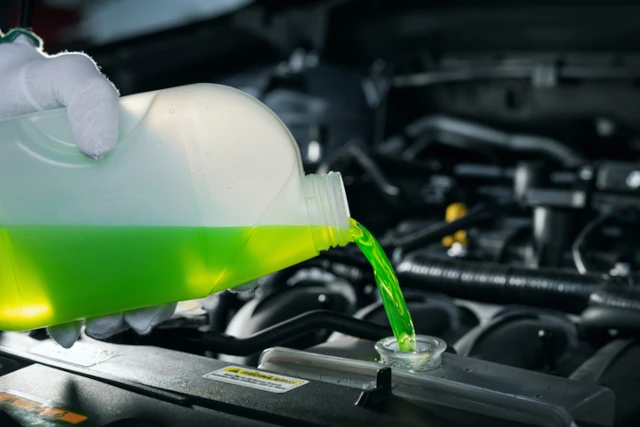
More modern vehicles use Organic Acid Technology (OAT) coolants, which do come with a higher upfront price when compared to the traditional Inorganic Acid Technology (IAT) coolants. Different brands will of course come with different price points, so it’s worth checking what you need, and what works with your budget yourself.
While OAT coolants come with a higher cost, they do last longer than IAT coolants. OAT coolants can last up to five years (or 150,000 miles, whichever comes first) before a replacement is needed, while IAT is recommended to be replaced every two years or 30,000 to 50,000 miles.
As a result, your upfront cost will be higher if you need to replace OAT coolants, but you’re going to be waiting longer before you need to make that purchase again.
Main Dealer Versus Independent Garage
It’s a well known fact that main dealers are more expensive than going to an independent garage for repair work. In certain areas, and depending on the manufacturer in question, the labour rate at a main dealer could be double that of a nearby independent garage. However, it’s worth noting that a main dealer will always use the OEM (original equipment manufacturer) approved parts and keep warranties intact. Independent garages can give you options on parts, meaning you can choose a lower quality item if you need to save money.
Signs Your Car Is Leaking Coolant
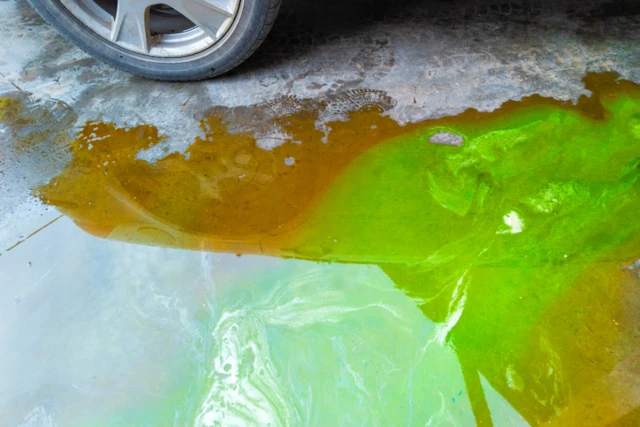
Coolant is easily identified if it’s leaking out of your car as it is often brightly coloured and comes with a sweet scent. If you find a bright green, pink, orange, yellow or blue puddle under your car, and it has a sugary or syrupy smell to it, then it’s highly likely you’ve suffered a leak. If you look under the bonnet when the car is cold and frequently see a the level drop, then this is another sign of a leak, as is dry, crusty residue or coloured stains on hoses, the radiator or water pump.
An overheating engine is also another key sign of leaking coolant, but it doesn’t guarantee a leak is present. An overheating engine could result in major damage to your power unit, so it’s worth taking it to a garage as soon as possible. Another sign you may notice from the drivers’ seat is when your dashboard vents blow cool even after your engine has warmed up.
Common Causes of Coolant Leaks
Hoses, Clamps and the Pressure Cap
Rubber, which is used to make the hoses and the seal around your pressure cap, degrades over time. In the case of hoses, this can cause them to become soft, brittle or even split, which causes leaks (or sudden bursts). As for the rubber seal on the pressure cap, or a broken internal spring, can allow coolant to boil over and escape from the overflow tube as either steam or liquid.
Finally, the clamps that hold the hoses tightly in place can weaken over time as a result of the constant vibration and thermal expansion within the engine. This can cause coolant to seep past the joint, or the screw clamps can cut into the rubber hoses, causing leaks in the hose much like rubber degradation.
Radiator and Expansion Tank
The radiator is exposed to the risks of the road as it sits at the very front of the vehicle. Road debris can make its way through the grill and puncture the radiator, which can cause leaks. Internal corrosion can also eat its way through the metal tubes, while the plastic tanks at the side can also crack over time as a result of thermal cycling.
Likewise, the expansion tank is also made of heavy-duty plastic, which can develop hairline fractures along its molded seams or hose connection necks as a result of aging.
Water Pump and Thermostat Housing
The water pump is actually designed to warn you that it’s wearing out before it suffers a total failure. Coolant will begin to appear out of a designated ‘weep hole’ in the event of worn internal bearings or a failing shaft seal. The thermostat housing, on the other hand, is often made of plastic or thin metal, which can warp as a result of overheating or the failure of the “O-ring” gasket, which causes coolant to pool on the top of the engine block.
Heater Matrix
The heater matrix is a mini radiator that sits behind the dashboard to keep your cabin warm. Old, unchanged coolant eats through the internal tubes and can cause leaks. You’ll notice this if there are we passenger footwell carpets or a greasy film across the inside of the windscreen.
Head Gasket Failure
The head gasket seals the engine block to the cylinder head, and severe overheating causes the cylinder head to warp, crushing the gasket and destroying the seal. As a result, coolant leaks into the combustion chamber, which causes white exhaust smoke, down into the oil passages, which creates a milky oil mixture, or externally down the side of the engine block. Head gasket failure is a major problem and you should have it taken to a garage as soon as you can.
Should You Repair or Replace the Radiator?
In most cases where there is physical damage to the radiator, it’s likely to be better off replacing your radiator than repairing it. Modern radiators are built with bonded aluminium and plastic components that makes patching a near-impossible task. If your car is old enough that it’s not built with these, it’s likely to now be so old that its brittle plastics will likely fail soon after a temporary patch is put in place anyway.
If you’re simply suffering from loose connections, such as a loose hose clamp or a degraded rubber gasket, these can often be replaced on their own without a complete replacement of the radiator itself. Likewise, a leaking drain cock or threaded transmission cooler line connection at the base of the tank can usually be resealed without having to replace the entire radiator.
Can You Fix a Coolant Leak Yourself?
You can fix a coolant leak yourself, providing it is regarding easily accessible external components like a rubber radiator hose, a loose clamp or a cracked expansion tank. If your leak is deep within the engine or involves internal engine seals, most notably regarding parts like the water pump, heater matrix or the head gasket, then this will require a professional mechanic’s assistance.
Is It Safe to Drive With a Coolant Leak?
Ideally, driving with a coolant leak should not be advised. A loss of fluid, no matter how small, can result in your engine overheating, which can lead to catastrophic failure and a hefty repair bill that far outweighs the cost of repairing the coolant leak itself.
If you have a tiny leak then you may be able to drive short distances and top up before each journey, but realistically this is not an ideal fix and should be looked at as soon as possible. A sudden burst from a split of cracked hose can drop the pressure down to zero in a matter of seconds, accelerating the risk of engine seizure exponentially.
If you see your dashboard temperature guage creeping up towards the red zone, feel cold air coming out of your heater vents, can smell a harsh, sugary burning odour or see thick white steam from under the bonnet, then you should stop the car immediately and get it taken to the nearest garage.
Will a Coolant Leak Fail the MOT?
Coolant leaks do not automatically mean you will fail an MOT, but if the leak is severe enough throughout the course of the inspection then it will be classed as a Major Defect and result in a fail.
The MOT inspection manual states that: You should fail a vehicle if a fluid leak creates a pool on the floor within 5 minutes that’s more than 75mm in diameter or if there are many leaks which collectively leak fluid at the same rate.
Anything within this tolerance will be noted as an advisory or Minor Defect. If the coolant is literally pouring out, then the tester can legally refuse to carry out the test on the basis that running the engine could cause it to seize while on the ramps.
There is also a knock-on effect that could result in failure. For example, if the loss of coolant causes engine overheating problems, it can prevent the garage from completing the mandatory emissions tests, resulting in either a legal refusal or a straight failure.
How Long the Repair Takes
Repairing a coolant leak can take everything from 30 minutes up to 15 hours worth of work. If all you need is a new pressure cap, a new clamp or one of the rubber pipes, then this could realistically be achieved within an hour or two. If you need a new radiator or thermostat housing, this could take up to four hours. A water pump replacement is likely to clock in around six hours due to the need to work around drive belts, pulleys and covers.
For big work such as heater matrix or head gasket, you’re looking at at least a day’s worth of work from the garage. A heater matrix requires the entire steering column and instrument panel to be removed simply to access it, while a head gasket replacement is one of the most labour intensive repairs that can be carried out on a car, requiring a complete dismantling of the cylinder head.
Who Pays for the Repair
In most cases the driver, or rather owner of the vehicle, will foot the bill. In some cases, though, you may be covered by external factors that can help keep the costs down.
Manufacturer and Extended Warranties
If the car is new enough, it may still sit within the manufacturer warranty. Most of these sit somewhere between three to seven years, and if yours is still under warranty then the manufacturer will cover 100% of the parts and labour cost if a component fails due to a manufacturing defect. In some cases, you may also get extended warranties from the dealer, or a used car warranty when purchasing a second-hand vehicle.
It’s worth noting that in many cases, extended warranties will not cover “wear and tear”, and items such as rubber hoses, clamps and plastic expansion tanks are likely to be regarded as “wearable items” that must be maintained by the owner, not covered by the warranty. Equally, if a driver ignores a warning light that results in serious mechanical damage, the warranty provider is likely to deny the claim.
Car Insurance
Your car insurance will not cover you if you have suffered mechanical failure. You will only be covered if the leak is the direct result of an incident that is covered under your policy, such as a front-end collision or striking a large piece of road debris that has punctured the radiator, or even vandalism.
Before making a claim, it’s worth weighing up the reality that you will still have to pay the voluntary and compulsory excess on your policy, and consider the impact it may have on your No Claims Discount.
Spreading the Cost
Many garages will offer finance schemes to pay for large repair bills, and in some cases short-term loans can come with 0% interest, allowing you to spread the cost over a couple of months rather than one big payment.
Other options involve utilising a 0% interest purchase credit card – if you have a good credit score – to spread the cost over several months, or alternatively delve into any emergency savings you may have. It can sometimes be difficult to actually dive into that fund, but that’s why it’s there in the first place.
Preventing Coolant Leaks
It may sound like a boring suggestion, but you can prevent coolant leaks by keeping up with your car’s designated maintenance schedule. Coolant should be flushed through and changed every two years (or 30,000 miles), unless you’re using OAT coolant, in which this can last up to five years before a change. Failure to keep up with this schedule means the coolant will become acidic and lose its anti-corrosion additives, which will eat away at the radiator and heater core like a parasite.
Breakdown recovery firm Green Flag lists inspecting rubber components such as hoses as one of the items that should be regularly inspected to keep your car running smoothly, and by doing so you could catch any potential leaks before they become a major problem. These will also be checked when your car has a major service.
When keeping a 50/50 ratio of antifreeze to water, make sure you use pure distilled water rather than tap water, as the latter introduces mineral deposits that can cause scale buildup and blockages. Always make sure you are using the correct type of coolant in line with your owner’s manual.
Is It Worth Fixing a Coolant Leak on an Older Car?
Scrap Car Comparison’s resident automotive expert, Matt Clamp, offers the following advice on fixing a coolant leak on an older car:
“As with any car problem, the decision of whether it’s worth fixing or not entirely depends on the car that you’re trying to repair. You need to weigh up the cost of the car itself against the cost of repairs. If it’s a small and simple repair like a simple hose or a clamp then by all means get it repaired. However, as soon as you start entering the realm of needing to strip parts or replacing major components, it starts to become a more nuanced question that requires more information before a decision can be made.”
Repair Cost Against Car Value
Generally, a repair is worth carrying out if it is less than 50% of the car’s current market value. The upfront cost of repairs are usually cheaper than the upfront cost of a new car, however it’s also worth taking into account whether or not this is a simple fix or one that’s simply going to patch a problem that’s going to reappear further down the road.
When a Head Gasket Tips the Balance
A blown head gasket can easily rack up repair costs approaching £1,000 at the low end of the scale, so on older or lower value vehicles (around the £2,000 price point), a head gasket is highly likely to render it a “write-off”, meaning that it’s not worth the repair cost. There’s also the added residual concern that repairing a head gasket doesn’t always fix any underlying issues that may have been caused by the original failed gasket, which could result in even more repair costs at a later date.
Selling a Car With a Known Leak
You can sell a car knowing it has a leak, but you must be open and honest about the car’s condition. Failure to disclose a known leak could put you in contradiction of the Misrepresentation Act 1967. The flipside is, of course, that disclosing this problem will shrink your buyer pool drastically, along with the price you can realistically expect to receive for it, which in turn extends the time the sale is likely to take. In some cases, you may be better off trying to sell the cars for spares or repairs.
The simplest option for getting the best price for your car in no time at all is to use Scrap Car Comparison’s service. Simply explain your car’s condition in detail to our team and we’ll find you a buyer instantly for your car, despite your leak or any other issues.
Scrapping a Car With Cooling System Damage
If your car has significant enough damage to the cooling system that selling privately is not an option, then scrapping is a guaranteed way to still get something from your car. Here at Scrap Car Comparison we have a network of approved, licensed and trusted buyers waiting for a car just like yours. The cost of a scrap car is largely governed by its weight, so a damaged cooling system won’t have an impact on your price like it would for a used car sale. In some cases, particularly for older vehicles that have suffered catastrophic engine damage, scrapping could actually be the most financially sensible move.
Authorised Treatment Facilities and Certificates of Destruction
An Authorised Treatment Facility (ATF) is the only place you can legally take a car to be scrapped. Your car will be put through the depollution process, which means all of its toxic fluids (like coolant) and materials will be safely removed before the metal is crushed. The ATF will then issue a Certificate of Destruction (CoD) as proof the vehicle has been permanently removed from the road and legally destroyed.
Telling DVLA and Handling the V5C
When you sell your vehicle to the ATF, you’ll complete the yellow section four of the V5C logbook (also known as the ‘sell or transfer a vehicle to the motor trade’ section), and the rest of the V5C will be given to the ATF. You must then immediately inform the DVLA that the car has been scrapped, which can be done online at the Gov.UK online portal, or by mailing the yellow section of the logbook to the DVLA’s Swansea address. You can be fined for failing to inform them.
When using Scrap Car Comparison, the paperwork is handled for you, so you don’t need to worry.
Outstanding Finance
If you still have outstanding finance on your car, legally you cannot scrap it. This is because the finance company still legally owns the vehicle until you have paid off the outstanding balance. In order to scrap the car, you must contact your finance provider to request a settlement figure. You will need full ownership of the car before the ATF can scrap it, or be able to provide written permission from your finance provider that you have been given the all clear to have it scrapped.
Road Tax Refunds and Private Plates
Any full months’ worth of road tax will be automatically refunded to you once your car has been processed as scrap by the DVLA. This only applies to pre-paid tax, and if you pay monthly your payments will simply stop with no refund.
If you wish to keep a personalised number plate, you’ll need to do this before you being the scrapping process. If the car is scrapped while still registered to your personal plate, then that registration will be destroyed along with the car itself. It will be removed from the DVLA database and can not be recovered.
Checking a Buyer Is Licensed
Under UK law it is illegal to pay for scrap cars in cash, so if your buyer offers you a cash payment, this should be your first red flag. All payments must be paid by bank transfer of cheque. You can also ask to see their Scrap Metal Dealer License or check the Environment Agency public register to ensure you are dealing with a legitimate buyer.
When using Scrap Car Comparison, you know you’re going to be working with a licensed buyer as we only deal with fully accredited and trusted buyers across the country.
Rules Across England, Scotland, Wales and Northern Ireland
Rules regarding coolant leaks are identical across England, Scotland, Wales and Northern Ireland. While vehicles in Great Britain (England, Scotland and Wales) are tested by DVSA testers, vehicles in Northern Ireland are inspected at an official DVA centre. Despite falling under different entities, both the DVSA and DVA adhere to the strict 75mm fluid leak threshold.
With regards to the disposal of engine coolant, which is regarded as a toxic chemical, the core rules remain standard across all four nations, but regulations are enforced by four separate national agencies.
These are:
- Environment Agency (EA) in England
- Scottish Environment Protection Agency (SEPA) in Scotland
- Natural Resources Wales (NRW) in Wales
- Northern Ireland Environment Agency (NIEA) in Northern Ireland
More Information
- How to choose which coolant is right for your car
- How to add and change car coolant
- Head gasket repair cost
- Things that will fail an MOT
FAQs
Why is my car losing coolant but no leak?
If you can’t see the link when your fluid levels are dropping, it’s likely that the leak is fully internal. This suggests the issue has been caused by an internal failure, such as a blown head gasket or cracked cylinder head. In some cases, if the leak is from a tiny pinhole, it could be vaporising as soon as it escapes due to the heat in the engine. Either way, you should take the car to a garage to be checked.
Can I just keep topping up my coolant?
Topping up your car’s coolant before every journey may keep your car running for short trips, but it is not a permanent fix and suggests there is a bigger problem to be addressed within the cooling system. There is also no guarantee that the small leak won’t suddenly get worse with a catastrophic burst, which could cause major engine damage within seconds.
Does radiator stop leak actually work?
Radiator stop leak products can temporarily seal small holes or minor weeping joints, but should not be considered a permanent or reliable fix. Consisten use of them can actually clog up the internal tubes of the radiator or heater matrix, and accelerate wear on the water pump’s seals. While they are not a permanent fix, they can be useful to get you to the garage for longer term repairs.
What colour is coolant when it leaks?
Coolant comes in a wide variety of colours, and modern coolants are often quite bright – either bright pink, orange, green, blue or yellow. You’ll also be able to tell if coolant has leaked as it has a sweet, syrupy smell to it. If the leak looks like a milky brown sludge, then this suggests it has combined with oil, suggesting head gasket failure or a ruptured oil cooler.
Can I use water instead of coolant?
Water can be used as a temporary road-side fix in an emergency, but is absolutely not recommended for permanent replacement to coolant. Minerals in standard tap water causes scale buildup, which can corrode metal components and block narrow cooling pipes. Water also has a much lower boiling point (and higher freezing point) than coolant, this leaves you much more at risk of it boiling over in summer or freezing in winter.
Does a coolant leak mean the head gasket has gone?
No, a coolant leak does not automatically mean the head gasket has failed. Most coolant leaks begin with simple fixes such as broken hoses, loose clamps, cracked plastic expansion tanks or stone-chipped radiators. If your head gasket has blown, leaking coolant is likely to be just one of the symptoms, alongside white smoke from your exhaust, a milky sludge under the oil filler cap or bubbles rapidly bubbling inside the expansion tank.
References
- https://environment.data.gov.uk/public-register/end-of-life-vehicles/registration?_limit=20
- https://www.gov.uk/scrapped-and-written-off-vehicles
- https://blog.greenflag.com/2026/pre-drive-checks-to-help-avoid-a-car-breakdown/
- https://www.gov.uk/guidance/mot-inspection-manual-for-private-passenger-and-light-commercial-vehicles/8-nuisance
- https://www.checkatrade.com/blog/cost-guides/coolant-leak-repair-costs