Sustainability is a key point for any business, and Scrap Car Comparison is no different. We’ve analysed the environmental benefit of salvaging vehicles when compared to scrapping them, and research shows that salvaging is usually the best way forward. This means that we will always propose a salvage quote for your car where possible – even if this may be slightly less than the scrap equivalent.
See what your car could be worth
Working with Valpak – leading consultants when it comes to ensuring companies are environmentally compliant – we found that more often than not, a brand new car will be purchased when somebody scraps an old one. We call this a “one-in/one-out” system.
One-in/One-out explained
Our data showed that over the course of the year, the numbers of cars that are scrapped almost perfectly aligns with those that are coming in to the road network. In effect, for every car that gets removed from the road, a brand new one takes its place.
This comes from our data which showed that in 2022 there were 35 million cars on the UK roads, a figure which stayed stable across a five year period to the nearest 500,000 (a margin of just 1.4%). In that year, 1.6 million cars were registered which implied that a similar figure (1.5 million) must have been scrapped.
This, compounded with further research showing the additional ecological impact of producing modern vehicles (explained below) shows that it’s generally much better for the environment to repair your car and get it back on the road than it is for a new one to be produced.
Not only is it better in terms of sustainability, it’s also better for you! The majority of salvage offers are more lucrative for you as a customer. This means you’re not only helping the environment, but also getting more money in your pocket!

Matt Clamp, Car Scrappage Expert at Scrap Car Comparison:
“At Scrap Car Comparison, environmental sustainability is at the core of our business decisions. We are dedicated to ensuring that all our practices, from operations to customer service, reflect our responsibility to protect the planet and reduce our ecological footprint.
With the findings from this report, we are confident that prioritising vehicle salvaging and repair over scrapping is the more environmentally responsible choice. Research demonstrates that extending the lifespan of vehicles through repair significantly reduces carbon emissions compared to the production of new vehicles. By focusing on salvaging, we reduce waste, minimize emissions, and actively contribute to resource conservation, reinforcing our mission to protect the environment and drive a greener future.“
How Did We Find This?
Coming to this conclusion took a lot of data analysis and comparison (luckily, comparison is what we’re good at). We looked at the types of cars that are being produced and bought by the UK’s drivers, including whether they run on petrol, diesel or electricity. Our data showed that while 94% of all cars on the road in 2022 were pure ICE (internal combustion engines – petrol or diesel), only 5% of new cars registered had a diesel engine.
Knowing there is a growing number of lower emissions cars entering the market, we then began to look into the environental impact surrounding the manufacture of new vehicles alongside the pollution created whilst driving and how this correlates.
Production vs Direct Emissions
While crunching the numbers, we found some incredibly interesting facts that show just how much of the pollution of a new ‘greener’ car comes before it has even turned a wheel. As the two graphs below show, comparing a Ford Fiesta and a Fiat 500e (both superminis but one with a petrol engine and the other battery powered), 65% of all emissions in the Fiat’s lifecycle comes from the production process – 45% in basic production and a further 20% to produce the battery alone. In contrast, only 16% of a petrol vehicle’s emissions come throughout the entire production process.
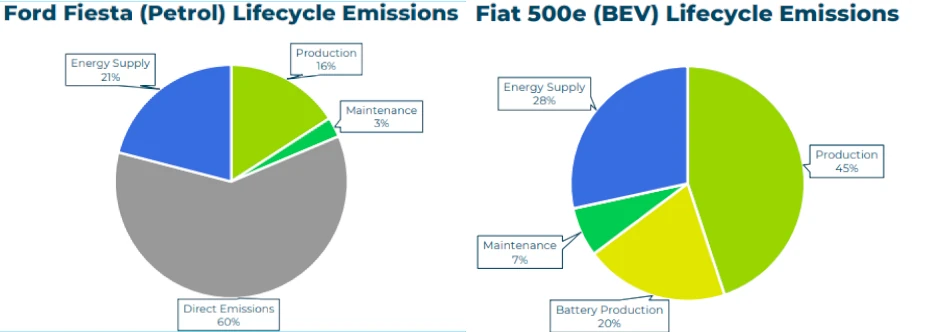
Based on our previous research regarding the One-in/One-out theory, in order for a new car to be produced, the emissions will be much greater from its production than that of an older dinosaur-burning ICE vehicle.
Using our sample of 64 different vehicles – including different powertrain methods and vehicle segments, we did some maths to work out just when it becomes more environmentally friendly to repair a car instead of adding it to the scrap heap. Using a rather clever chart we could see the miles a car would need to have left in its expected lifetime, plotted alongside the CO2 emissions it produces per kilometre, and mark the exact point when repairing stops being worthwhile.

| Declared Emissions (g/km) | Threshold Mileage (scrap if under) |
|---|---|
| <141 | Repair |
| 141 | 0 |
| 145 | 8,000 |
| 150 | 16,500 |
| 155 | 24,600 |
| 160 | 32,200 |
| 165 | 39,400 |
| 170 | 46,100 |
| 175 | 52,400 |
| 180 | 58,300 |
| 185 | 63,700 |
| 190 | 68,700 |
| 195 | 73,200 |
| 200 | 77,300 |
| 205 | 81,000 |
| 210 | 84,200 |
| 215 | 86,900 |
| 220 | 89,300 |
| 225 | 91,200 |
| 230 | 92,600 |
| 235 | 93,600 |
| 240 | 94,200 |
| >240 | Scrap |
So what exactly was that maths that we talked about a moment ago? It was all about calculating an emissions ‘cost’ of scrapping a car and an emissions ‘saving.’
To work out the ‘cost’ we factored in emissions associated with the scrappage:
- Emissions associated with the manufacture of the car it’s replaced by (based on the ‘one-in/one-out’ basis).
- Emissions associated with driving the new car over the distance that could have been driven had the scrapped car been repaired.
To make it fair, we also worked out the emissions ‘saving’ when scrapping:
- Emissions associated with repairing the car
- Emissions associated with driving the car for the rest of its usable life
But what does it mean? Well, if the ‘saving’ emissions are greater than the ‘cost,’ you’re better off scrapping your car.
In more technical terms, if the scrapped car has higher exhaust emissions than the new car you replace it with, and sufficient driveable miles that the total emissions outweigh the manufacturing emissions of the replaced car, then it was the correct decision.
After a car crosses a certain ‘threshold,’ it no longer has sufficient emissions potential to outweigh the emissions cost of manufacturing a more efficient car, so it’s better to repair it.
It’s complicated, we know. Here’s a simplified visual that we think demonstrates when most cars end up becoming a suitable repair job.

Get in touch to see what we can do for you
No matter where your car sits on our graphs, we can get you a great price for your old car. Where possible we’ll always try to get the best salvage deal on the table, but we’re happy to be lead by you. To find out what your car could be worth as scrap or salvage, just give our team a call on 03333 44 99 50 or use the quote form at the top of this page.
If you are interested to read further, the full report produced by Valpak can be found here:
 Car Maintenance Knowledge Hub
 Car Maintenance Knowledge Hub
Read on for more expert advice on everything car maintenance, repair and servicing. From cleaning and servicing to changing oil or simple engine repairs.
How to Find OEM Car Part Numbers
When you’re looking for a replacement car part, you need to find one that matches in both fit and performance. Here’s how you can find OEM part numbers.
How Long Before Radio Drains Your Car Battery?
When you’re listening to your car radio without the engine running, your battery is draining. This is how long it’ll last before it dies.
What to do if a car immobiliser is faulty
Has your immobiliser started playing up? Find out how to fix and what to do with it thanks to Scrap Car Comparison’s handy guide
How to Fix an Exhaust Smell in Your Car
This guide walks you through everything you need to know after your car’s been totalled.
Or visit our Car Maintenance Knowledge Hub and browse all the expert advice

Scrap a Car in Your Area
Scrapping an old car doesn’t have to be stressful. Scrap Car Comparison can get you a great price and quick, free collection. Get an instant quote now or browse our scrap locations.